| TL;DR: Credit union mergers freeze technology decisions the moment they go public. The critical window is the 6 to 12 months before the announcement, not after. Three categories of decision get frozen: new vendor onboarding, staff training on existing tools, and member communication infrastructure. Most CU leaders miss the pattern until conversion week, when it is too late. This article will give you an understanding about the right time to start this conversation. |
There is a window in every credit union merger that opens well before the announcement and closes the moment it goes public. Inside that window, leadership makes the technology decisions that determine what the merged institution uses to serve members on Operational Day One. Outside it, the same decisions become effectively frozen.
The window matters because merger activity is not slowing. The trade press expects more than 200 credit union mergers in 2026, following 162 in 2024 and 157 in 2025. Enough of that activity is happening in most regional markets that a serious merger conversation is not a distant possibility for most CU leadership teams.
The window typically opens when a merger conversation starts to gain weight, whether that is a phone call from a peer CEO or a strategic board session that gets more specific than usual. It has 6 to 12 months in it. By the time most CU leaders recognize it is open, the room to act on it has narrowed considerably.
The credit union M&A article introduced this pattern as the 12-Month Rule. If you haven’t read it, we recommend that you start there.
Here, we’ll name the specific technology decisions that freeze at announcement, and explain why the routine diagnostic signals stop working during merger integration.
Why Signing Contracts Doesn’t Mean Deploying Them
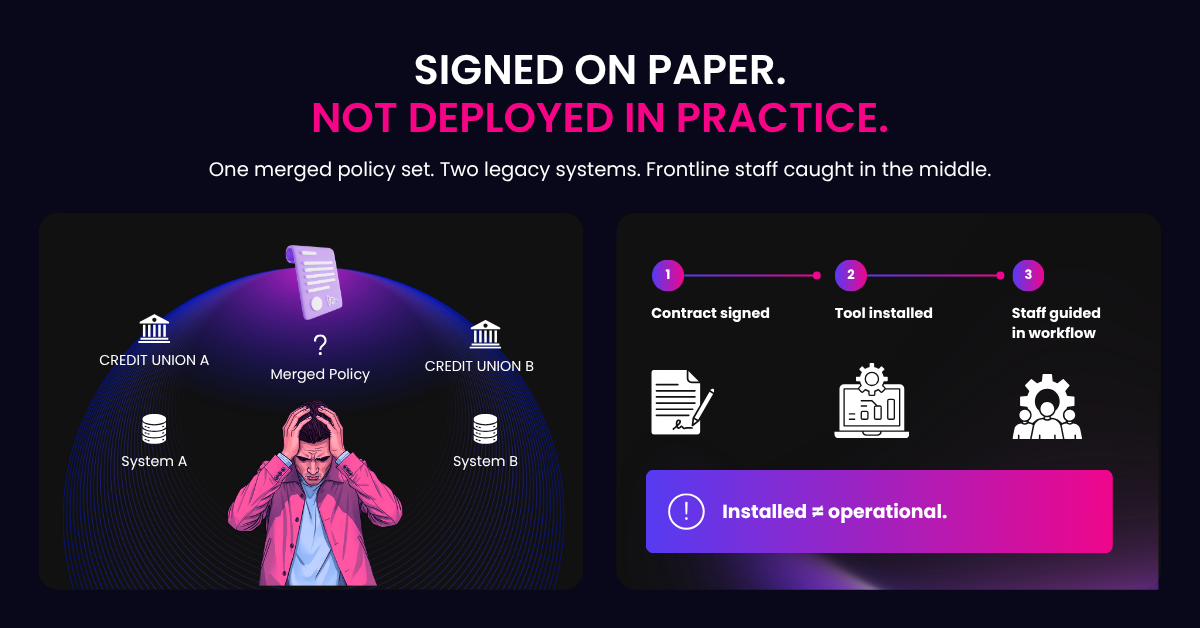
The hardest operational problem in a credit union merger is not bandwidth. It is that frontline staff at both institutions become accountable to merged-entity policies they have not been briefed on, while still operating the systems they had before Legal Day 1.
A member walks into a branch and asks about a fee schedule. The teller answers from the policy they know. Leadership finalized a different position last Friday. The teller does not know that yet. The answer is wrong. The member notices. The question escalates.This is not a training gap that a Monday morning update fixes. Policy changes weekly across compliance, lending, fee schedules, and product terms. It is unrealistic to expect staff to memorize policy decisions finalized by leadership on Friday and successfully execute them by Monday.
Bandwidth is the second constraint. Even when a credit union wants to close the knowledge gap with tools, integration workstreams have already claimed the operations team. This is not a planning failure. It is a hard operational truth. Credit unions do not have supplemental staff standing by. The same team that serves members every day is the same team that has to execute the merger. Better planning does not fix this. Tools that execute inside a shrinking window do.
Cornerstone Advisors documented in their Next-Level Growth report, cited in The Financial Brand, that roughly one in four credit union technology projects fails to reach full implementation. Deployment failure is not just a bandwidth story. When a tool gets installed but staff never receive consistent guidance on how it fits with existing policies, the tool is live on paper and useless in practice. Merger integration compounds this. The volume of new merged-entity policies overwhelms whatever knowledge infrastructure staff had before.”
D Hilton Associates captures the same reality in different language: final regulatory approval represents “the completion of the merger on paper, but not in actuality.” Operational integration runs six months to two years past Legal Day 1. Through that window, two credit unions live under one merged-entity policy set while operating two separate technology footprints. The knowledge gap is the operational gap.
What Are the Three Technology Decisions That Freeze at Announcement?
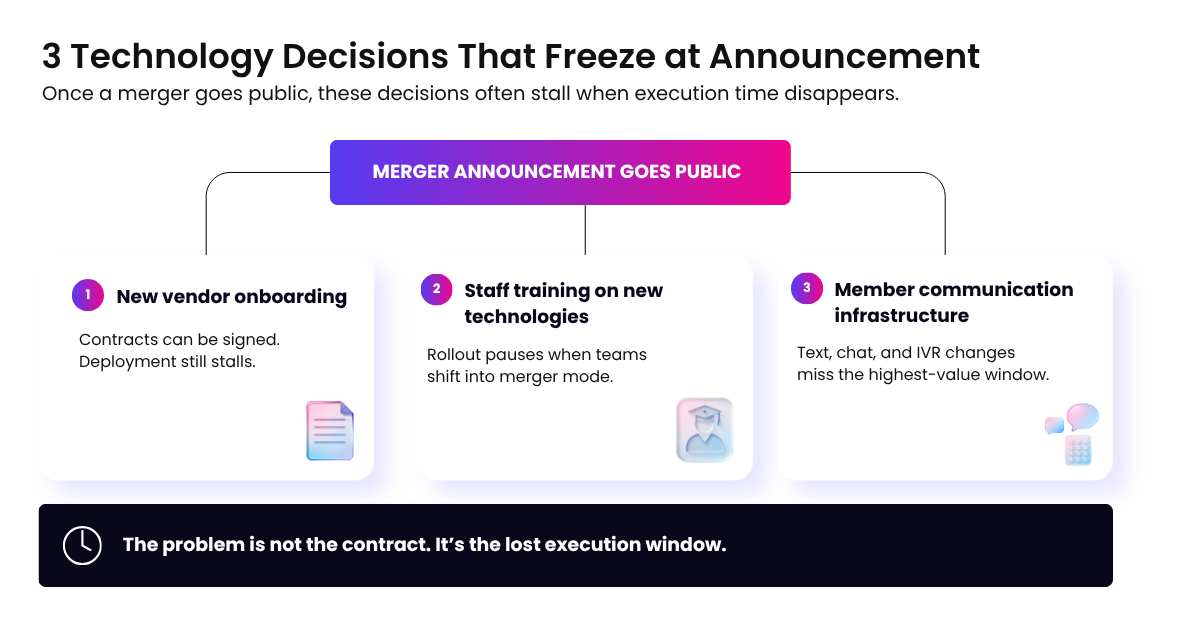
Three specific categories of technology decisions freeze the moment a merger announcement goes public. They are not the only decisions that freeze, but they show up most consistently in the merger post-mortems we see across the credit unions Eltropy works with.
1. New vendor onboarding
Net-new vendor procurement is the category most CU leaders assume is safe post-announcement because contracts can still be signed. In practice, signed contracts sit unactivated for months because the operations team that would normally handle deployment is fully committed to integration workstreams.
A credit union that signs an AI vendor contract two months after the announcement needs time to configure the tool, integrate it into workflows, and train staff on it. That time rarely exists inside merger integration.
2. Staff training on new technologies
This category surprises most CU leaders because it applies even to tools the institution already owns. Once the announcement lands, broader rollout to remaining staff effectively stops. The training team is booked with merger orientation, new joint operating procedures, and cross-institution familiarization. Rollout waits until integration completes, which can be a year or more later. By then, the technology’s highest-value window, conversion week and the weeks around it, has already passed.
This is the specific window where a staff-facing knowledge tool matters most. Eltropy’s AI assistant i.e the knowledge assist is a single source of truth for merger-specific policies and procedures, live by Operational Day One when it is needed most. Staff at both credit unions query one system and get the current, merged-entity answer, whether the query comes from a teller in one branch or an agent in the contact center at the other institution. Credit unions that deploy it before the announcement give staff a working knowledge base for the Legal-to-Operational gap, when they are working across two sets of systems and two sets of documentation.
3. Member communication infrastructure configuration
Text messaging campaigns, chat flow adjustments, and voice IVR routing all require configuration effort that the marketing operations team cannot provide during merger integration.
A credit union planning to run merger-specific communication campaigns to prepare members for a vote will find that the marketing team is spent on integration marketing, brand transition planning, and member vote logistics. Configuration slips to post-close, missing the exact window when the campaigns had operational value. Lumin Digital captured the same dynamic: digital transformation timelines rarely align with transaction timelines. Deals get announced in the spring and closed by summer, but the technology integration underneath unfolds over a much longer horizon.
The three categories above name what freezes. The next question is why most CU leaders don’t see it happening until conversion week.
Why Do Diagnostic Signals Stop Working During Merger Integration?
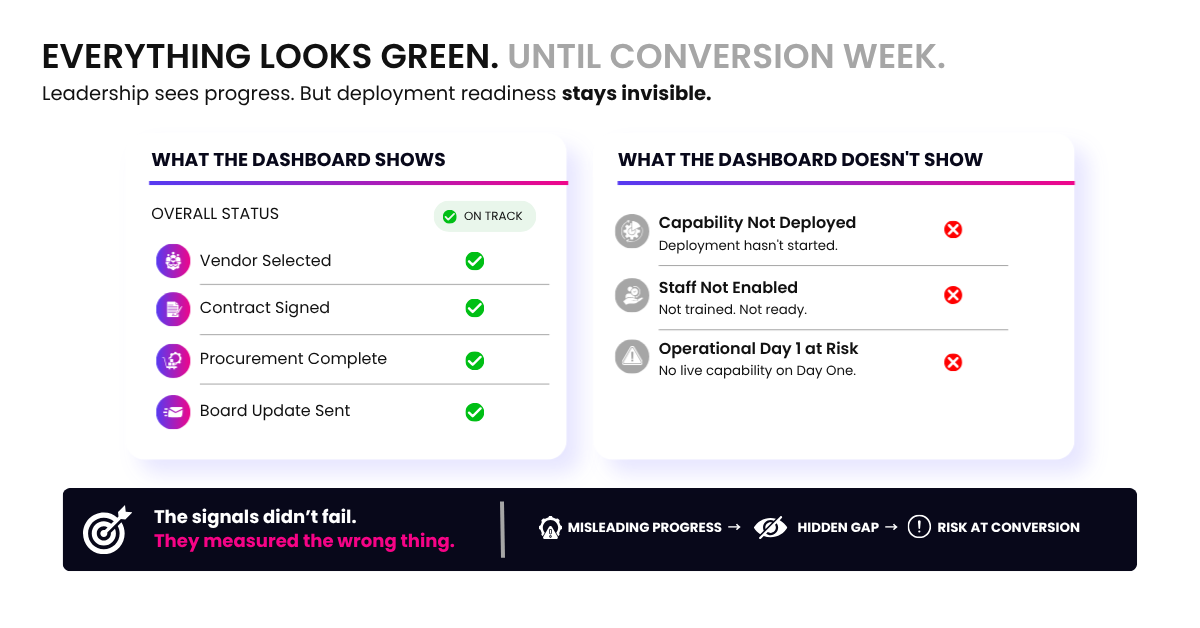
CU leaders who have been through a merger describe the same pattern to us. The purchases happen on schedule. The deployments do not. By the time conversion week arrives, the tools that were supposed to be operational are either untrained, unconfigured, or still in the box.
The 12-Month Rule creates a specific blind spot for CU leadership. Most operational diagnostics work well for steady-state operations. Merger-state breaks them.
In steady-state operations, contract signature and capability deployment happen within weeks of each other. A CIO signs a texting vendor contract, deployment starts a few weeks later, staff are trained by the following quarter. Signature and deployment read as the same event.
Merger integration breaks that assumption. Signature and deployment become separated by months, sometimes a year or more. Meanwhile, the routine signals tell a CU leader the tech stack is on track. Vendors get selected. Contracts get signed. Procurement continues. The CIO’s dashboard shows activity. Board reports show progress.
None of those signals distinguish between a contract that deploys inside the window and one that sits dormant until Operational Day One. By the time conversion week arrives and the gap becomes visible, the pre-announcement window has been closed for months.
Forbes reached the same conclusion in a June 2026 analysis of CU-of-bank acquisitions: “It should be table stakes to plan for platform integration well before any deal is made.” The framing applies just as directly to credit union mergers of equals.
What Are the Three Questions to Bring to Your Next Executive Meeting?
Credit unions run merger strategy with their M&A advisor. Doeren Mayhew, CEO Advisory Group, SRM, D. Hilton, and Samaha & Associates own the strategic work: deal structure, financial due diligence, cultural alignment, regulatory navigation. What follows the strategic recommendation is operational execution. That is where Eltropy fits. The technology that brings the strategy to life on the day staff and members have to live inside it.
M&A technology frameworks exist. Samaha’s Top 10 Technology Questions and ALM First’s board-level questions are good places to start. The three below focus on the pre-announcement window: what your team can act on before the merger becomes public.
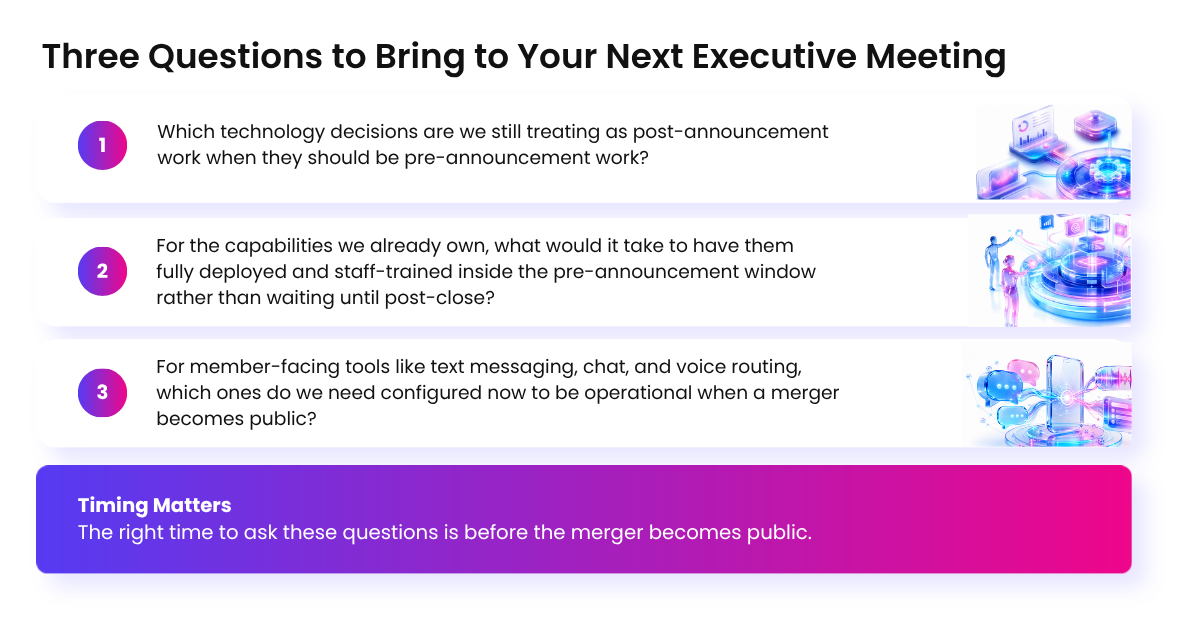
Which technology decisions are we still treating as post-announcement work when they should be pre-announcement work? Any decision that requires vendor onboarding, staff training, or configuration effort belongs in the pre-announcement window if a merger is realistically 6 to 12 months out.
For the capabilities we already own, what would it take to have them fully deployed and staff-trained inside the pre-announcement window rather than waiting until post-close? Existing tools with incomplete rollout are often the fastest lever available because procurement is already done and the vendor relationship exists.
For member-facing tools like text messaging, chat, and voice routing, which ones do we need configured now to be operational when a merger becomes public? These tools take weeks to configure. If they are not built pre-announcement, they will not exist when needed.
The three questions are not a prescription. They are a diagnostic. The right answers depend on what your credit union has already deployed, what the merger partner looks like, and how far out the announcement realistically is. The right time to ask them is before the merger becomes public. That is the entire point of the 12-Month Rule.
When is the Right Time to Start This Conversation?
Most CU leaders won’t publicly announce a merger this quarter. Some are already inside the window and haven’t recognized it. If your board has discussed strategic partnerships recently, or your team is running scenario planning on peer institutions, the window is likely open right now.
Eltropy has been the conversation partner for a subset of the 750+ credit unions and community banks we work with, helping leaders think through which technology decisions are still theirs to make before a merger becomes public.
If a merger is realistically 6 to 12 months out for your credit union, three next steps for this quarter:
- Talk to your existing vendors about how they can assist you during the merger process. Their answers show you where your pre-announcement window is tightest.
- If you’re already an Eltropy customer, reach out to your CSM. They can run a rapid audit of what’s activated versus what’s dormant across your Eltropy footprint, so you know exactly which capabilities are ready and which need pre-announcement work.
- If you’re not yet an Eltropy customer, talk to us. We’ll help you think through which technology decisions are still yours to make before a merger becomes public.
Frequently Asked Questions
What technology decisions freeze after a credit union merger is announced?
Three specific categories of technology decision typically freeze at merger announcement: new vendor onboarding, staff training on existing tools, and member communication infrastructure configuration. Each requires operational bandwidth that vanishes once integration workstreams claim the executive calendar. The pre-announcement window is when these decisions have to be made and deployed.
When should credit unions start planning merger technology?
Meaningful pre-announcement planning starts inside the 6 to 12 month window before a merger becomes public. This is when technology decisions can still be executed with operations bandwidth intact. Once the announcement lands, deployment capacity vanishes into integration workstreams. Technology work that has not started by then usually does not finish before Operational Day One.
Why do credit union technology projects fail to launch on schedule?
One in four credit union technology projects fails to reach full deployment on schedule, per Cornerstone Advisors and Blend’s 2025 “Next-Level Growth” report, as reported by The Financial Brand. The pattern shows up across online banking, digital account opening, and CRM systems. Merger integration compresses bandwidth further, making the problem worse.
What is the difference between Legal Day 1 and Operational Day One in a credit union merger?
Legal Day 1 is the date the merger closes on paper following final regulatory approval. Operational Day One is the date the two credit unions actually operate as one, with combined systems, unified policies, and shared staff. D. Hilton Associates describes Legal Day 1 as “the completion of the merger on paper, but not in actuality.” The gap between the two dates typically runs six months to two years.