| TL;DR: During a merger, one credit union can give a member two different answers to the same question on the same day. The policies merge slower than the legal structure does, and an AI tool only helps if it is set up and loaded with the reconciled policies before Legal Day 1. This article explains why that happens, and why the fix has to be in place before the merger is announced. This article will give you an understanding about the right time to start this conversation. |
A member walks into a branch of her newly merged credit union and asks about a wire limit. She gets one answer. Her significant other asks the same question at a different branch that afternoon and gets a different one.
Same credit union, same day, two different answers.
On paper, the merger is done and it’s officially one credit union. But the policies behind that wire limit have not caught up, and until they do, the institution cannot give its own members a single, consistent answer.
While many credit unions rely on AI tools to drive consistency, technology can’t fix a policy disconnect – and that core issue is exactly what this article explores.
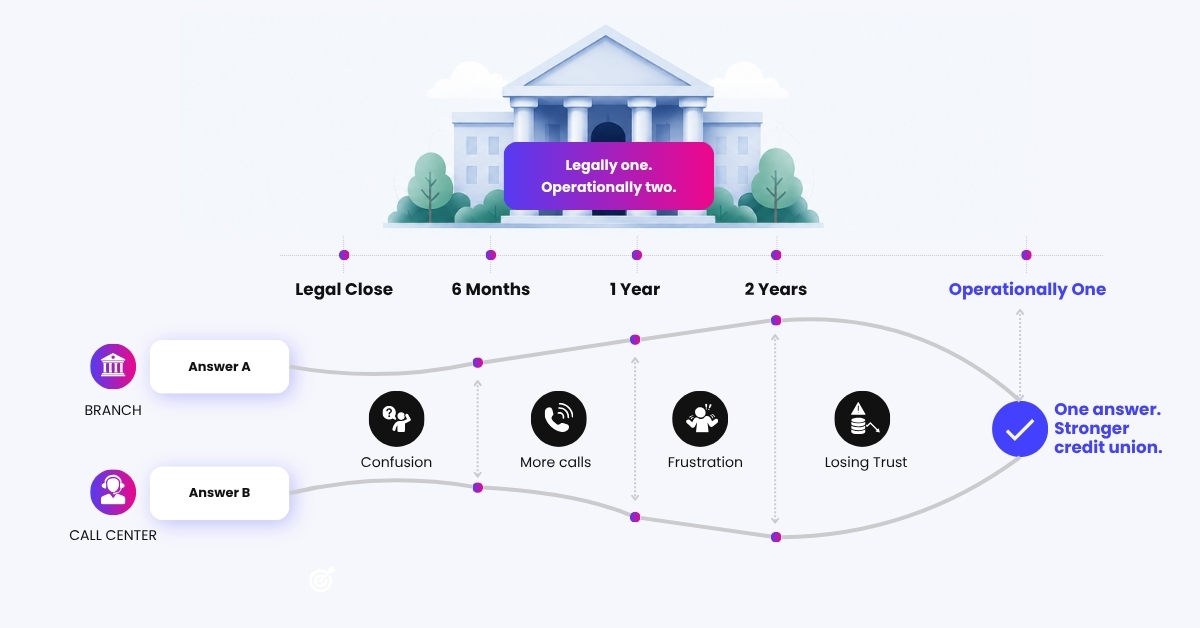
Every merger produces divided answers. What matters is not that it happens, but how long it goes on.
Two answers from one credit union is normal at first
Staff at each branch answer from the policies they were trained on. During a merger, those policies have not been combined into one set yet. So a member can get one answer at a branch and a different one from the call center. Anyone who has been through a merger has seen this. It is not the surprising part.
The surprising part is how long it lasts
These two answers are not a first-week problem that clears up by Friday. They last for the whole stretch between the legal close and the day the credit union actually runs as one. D. Hilton Associates calls final regulatory approval “the completion of the merger on paper, but not in actuality,” and puts that stretch at six months to two years. For that entire time, the credit union is legally one and operationally two.
The longer it runs, the more it costs. Filene Research Institute finds that operational and cultural mismatch is what quietly undermines mergers. Every time a member gets one answer at the branch and another at the call center, the merger’s promise of a stronger credit union gets harder to believe. This is the pattern we see across the credit unions we work with. The divergence is ordinary. Its length of time that does the damage.
This is a staff alignment problem before it is a member problem, which is the case the credit union M&A article makes in full.
Why AI Doesn’t Close This Gap on Its Own
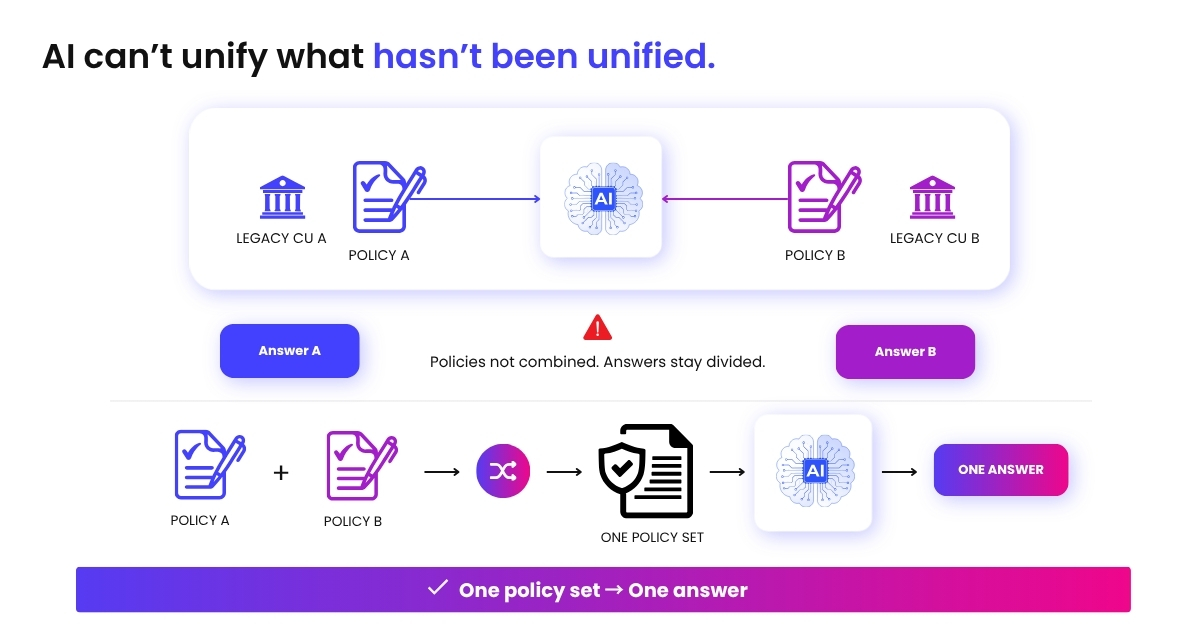
Credit unions expect the AI they already have to keep answers consistent. It can’t, and it comes down to the data set the tool is working from.
The AI only answers from what it is given
Many merging credit unions already have a staff-facing AI meant to give employees one consistent answer. Going into the merger, it looks like the fix. It is not, and the reason is simple.
AI answers from the policies it is loaded with. Load two policy sets, and it gives two answers, because each one is correct for its own legacy institution. The tool is doing its job. The problem is underneath it, in a policy layer that has not been combined yet. These are two separate failures. In Get Your AI Knowledge Assistant Live by Legal Day 1, we covered the first one: the tool never going live in time because the work to activate it gets crowded out by the merger. This piece is about the second, which bites even when you avoid the first. A tool that is fully live still gives two answers if the policies beneath it were never reconciled.
The work that would fix it gets deferred
Closing the gap means combining the policies and loading one clean set into the shared tool. That work needs two things, and a merger takes both away at the worst time.
The first is a settled set of policies, which is still being worked out during integration. The second is the operations team, which gets pulled into the deal. America’s Credit Unions warns that plans have to rest on a candid look at staff capacity and competing priorities, because without it even strong strategies struggle in execution.
A merger brings the biggest set of competing priorities a credit union will ever face. The people who would combine the policies and load the tool are the same people running the deal. This is not a planning failure. Credit unions run lean by design; there is not a bench of extra staff sitting idle. The same people carry the daily work and the merger at once, so the loading gets pushed aside not by choice but because there is no one free to do it.
This window doesn’t have to close this way
The window of conflicting answers is not an inevitable requirement of merging; its duration depends entirely on timing. By establishing clear policy choices prior to announcing the deal, a credit union enables its operations staff – while they still have capacity to populate the unified system with a single, consolidated source of truth. Implementing this early groundwork ensures the institution delivers unified answers from Legal Day 1. For a detailed roadmap on organizing these pre-announcement steps, refer to the AI Playbook whitepaper.
The Two Problems That Run the Length of the Legal-to-Operational Gap
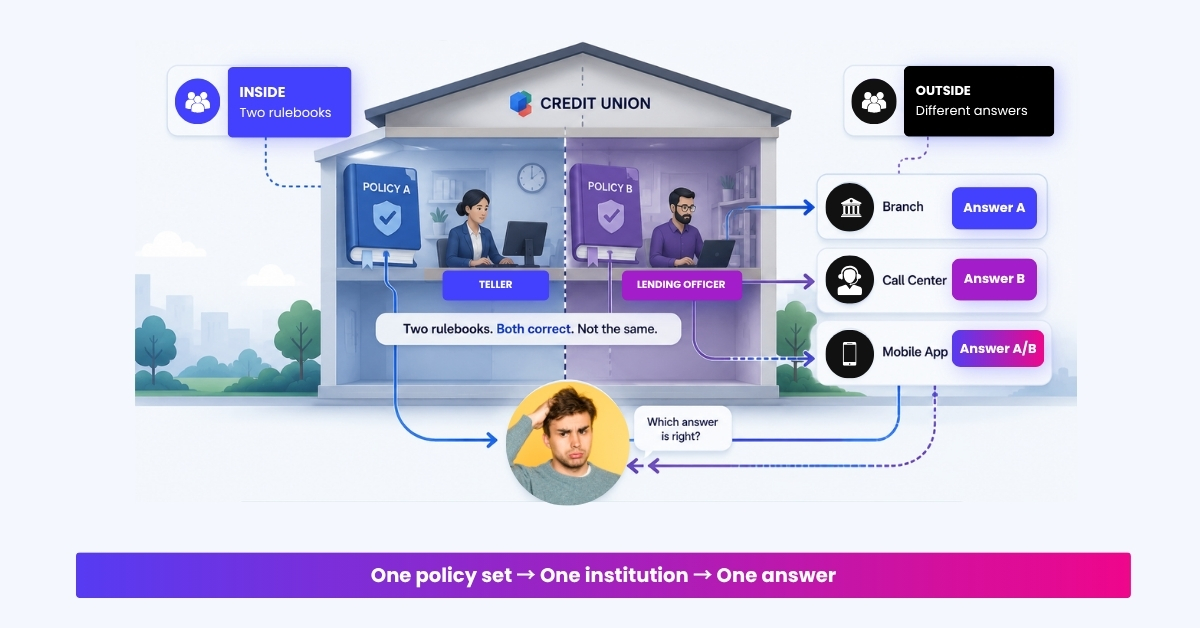
The divided answer shows up in two places at once, and both last until the policies are settled.
Inside: staff working from two policy sets
Until the policies are combined, staff are the ones absorbing the gap. A teller at one legacy branch works from one rulebook, a lending officer from the other works from a different one, and neither is wrong. They are doing their jobs with the information they were given.
The cost of that lands on them. Staff are the ones who face the member when the answer turns out to be wrong, who take the frustration for a policy they didn’t set, and who lose confidence every time they give an answer they cannot be sure of.
Issuing an alignment memo, or urging staff to try harder is not the solution. Good employees start to feel less confident in their job through no fault of their own, and in the middle of the merger when people are already concerned about retaining their position, this extra pressure causes top talent to start looking for opportunities elsewhere.